
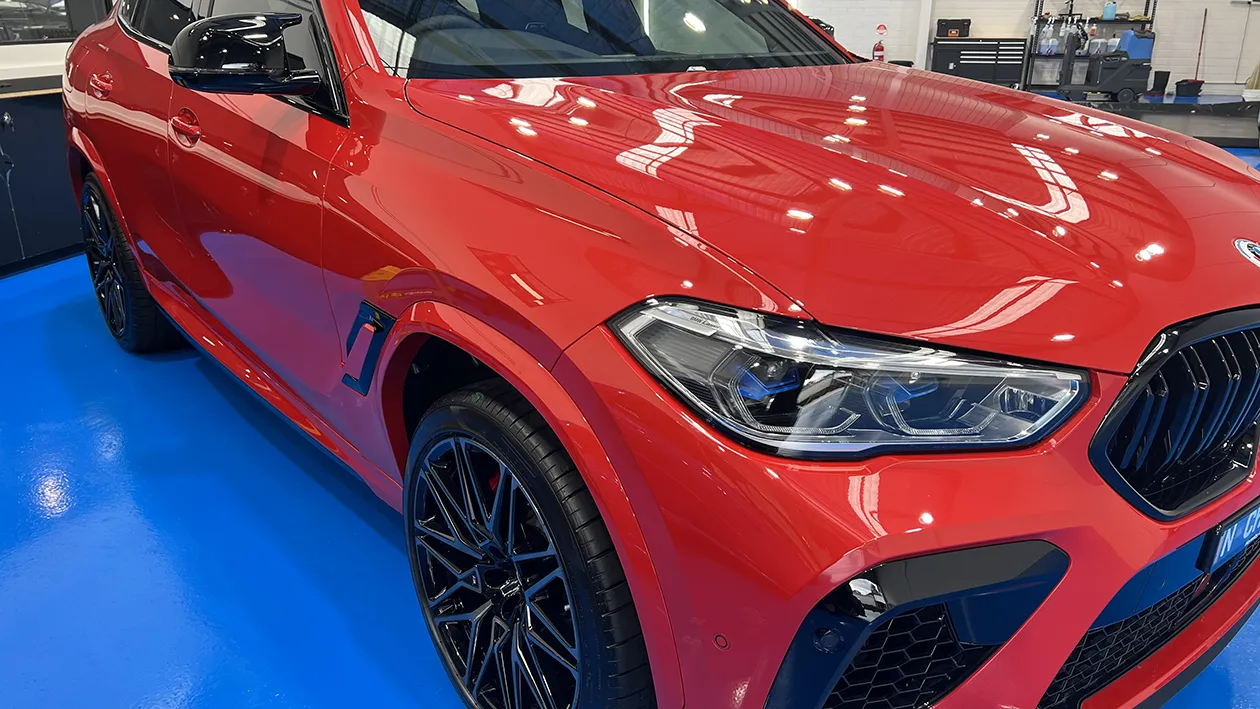
Graphene coating is a liquid paint protection product that bonds to your car’s clear coat. In most cases it’s a ceramic (silica-based) coating with graphene oxide added. Graphene is a single layer of carbon atoms arranged in a honeycomb pattern; in car coatings it’s usually added as graphene oxide in small amounts. It gives your paint strong water beading, a very slick finish, and protection from bird droppings, tree sap and UV. Durability claims range from one year to ten, depending on the brand. Either way, it beats wax.
Is graphene coating good for your car? Yes, as long as the paint is properly prepared before it goes on. The bottle matters less than the prep and the application. If you’re planning to do it yourself, three things decide whether it works:
- Properly prepared paint. That means fully decontaminated, and polished if there are any swirls or scratches.
- A covered, dust-free space out of direct sun, with a stable temperature.
- A full day. Realistically 8 hours or more for a first-timer, working one panel at a time.
You can apply graphene coating yourself or have it professionally installed, and this guide covers both. We’ve been protecting cars at our Castle Hill workshop for over 20 years. We install graphene coatings, and we’re also a Gtechniq Accredited Detailer. For long-term protection, we recommend Gtechniq Crystal Serum Ultra, because it has a longer track record and a guarantee of up to 9 years. In our experience, once customers compare the two, they choose Gtechniq.
What Are the Real Downsides of Graphene Coating?
The biggest downside of graphene coating is the preparation it needs before you apply it. It also won’t stop rock chips. And because it’s a newer category than traditional ceramic coatings, there’s less real-world evidence of how it holds up over years of harsh Australian sun.
Here’s what that means in practice:
- Prep is most of the job. A coating locks in whatever is underneath it. Swirl marks, water spots and light scratches get sealed in for years.
- It doesn’t stop rock chips or deep scratches. No liquid coating does, whatever the marketing says. If you want impact protection on the bonnet, bumper or mirrors, you need paint protection film.
- It’s a young category. Graphene car coatings arrived around 2020, while Gtechniq has been refining its coatings since 2001. That matters more in Sydney than in most places. ARPANSA data shows Sydney’s UV Index sits at 3 or higher every month except June and July, so a coating parked outside here works hard for ten months of the year. A five-year claim from a product that hasn’t spent five full years on Australian cars is still mostly a promise.
- You often don’t know how much graphene is in it. Most brands don’t disclose the concentration, even in professional products, and some “graphene” products are standard ceramic coatings with a small amount added for marketing appeal.
- DIY means there’s no installer behind it. If a DIY coating fails early or goes on badly, you’re on your own. There’s nobody to inspect it, fix it or honour a warranty.
- DIY mistakes are hard to undo. A high spot that cures properly may need machine polishing to remove, which can mean paying a professional to fix the job anyway.
How Long Does Graphene Coating Last?
Most graphene coatings claim one to five years, and some claim up to ten. How long yours lasts depends far more on prep, application and aftercare than on the bottle. A coating applied over uncorrected paint, or washed with harsh chemicals, can lose its beading within months.
Key takeaway: Prep is 90% of the work. If your paint has scratches or swirls, a graphene coating will lock them in for years. Get the paint right first, or don’t coat it at all.
Should You Coat Your Car This Weekend? A Quick Checklist
Answer yes or no:
- Do you have a garage or covered space that stays out of the sun all day?
- Can you set aside at least 8 uninterrupted hours?
- Is your paint free of swirls and scratches when you check it under a torch? If not, do you have a machine polisher and know how to use it?
- Can you keep the car dry and undercover for about a week afterwards?
- Are you comfortable polishing out a high spot (a patch of coating that wasn’t buffed off in time) if you miss one?
If you answered “no” to any of these, a professional installation will almost certainly give you a better result, and it’ll last longer.
Is Graphene Better Than Ceramic Coating?
Only slightly, and mostly for slickness and water-spot resistance. Most graphene coatings are ceramic coatings with graphene added, so the more useful questions are who applies it, how long the product has been proven, and what’s guaranteed in writing.
Here’s how the main options compare:
| Traditional Wax | DIY Graphene Coating | Professionally Applied Graphene | Gtechniq Crystal Serum Ultra | |
|---|---|---|---|---|
| Who applies it | You | You | A trained installer | Gtechniq Accredited Detailer only |
| On the market since | Decades | Around 2020 | Around 2020 | 2017 (Gtechniq founded 2001) |
| Typical durability | Weeks to a few months | 1 to 10 years claimed, varies by brand | Varies by product and installer | Guaranteed for up to 9 years when maintained to Gtechniq’s care requirements |
| Warranty | None | Usually none | Varies, so ask for it in writing | Manufacturer guarantee plus installer workmanship |
| Structure | Soft wax layer | Single layer, graphene content often undisclosed | Single layer, graphene content often undisclosed | Dual layer: flexible base and a hard top layer |
| If application goes wrong | Easy to remove | May need machine polishing | Installer’s responsibility to get right | Installer’s responsibility to get right |
| Best for | Short-term shine | Keen DIYers with the right space and gear | Owners who want a professional graphene finish | Owners who want long-term protection with a proven track record |
You’ll often see claims that graphene coatings run cooler, self-heal or resist rock chips. Graphene does conduct heat well as a raw material, but the small amounts used in car coatings haven’t been shown to make a noticeable difference to paint temperature. No liquid coating stops rock chips, and “self-healing” belongs to PPF, not coatings.
Professional Graphene Coating vs Gtechniq Crystal Serum Ultra
Both are applied by a trained installer after paint correction, so the difference comes down to the product and what stands behind it. Crystal Serum Ultra has been on cars since 2017, and Gtechniq has been refining its coatings since 2001. It’s backed by a guarantee of up to 9 years, and only accredited detailers can apply it. Professional graphene coatings are newer, their graphene content is rarely disclosed, and warranty terms vary from installer to installer.
We offer both at our Castle Hill workshop. In our experience, once customers compare them side by side, they choose Gtechniq.
Whichever you’re considering, ask the installer three questions:
- What’s guaranteed, and for how long, in writing?
- How long has this product been on cars in Australia?
- What paint correction is included in the price?
Choose a DIY graphene coating if:
You enjoy detailing, have a garage and a machine polisher, already know paint correction, and are happy to accept the risk of a DIY result with no warranty.
Choose professionally applied graphene if:
You specifically want a graphene coating and a professional finish, without doing the prep yourself. Ask for the warranty in writing before you book.
Choose professionally installed Gtechniq Crystal Serum Ultra if:
You want the longest-lasting protection, a guarantee you can rely on, and an installer who has corrected your paint and applied the coating in a controlled workshop. Because Crystal Serum Ultra is so durable, Gtechniq only allows trained, accredited installers to apply it. If it’s applied incorrectly, it has to be wet sanded off. That’s a job you don’t want to DIY.
What Is Better Than Graphene Coating?
For paint, a professionally installed ceramic system with a proven track record and a written guarantee, such as Gtechniq Crystal Serum Ultra, is the better choice for most owners. For rock chips, nothing liquid compares with paint protection film (PPF). Many owners combine the two: PPF on the bonnet, bumper and mirrors, and a ceramic coating on everything else.
Is Graphene Coating Better Than PPF?
No, they do different jobs. Graphene coating protects against water spots, contamination and UV. PPF is a thick, clear film that absorbs stone impacts. If rock chips are your concern, you need paint protection film.
For more detail, see our ceramic coating service.
How to Apply Graphene Coating Yourself (Complete DIY Guide)
Yes, you can apply a graphene coating yourself. You’ll need a controlled environment, the right preparation products, and patience. Here’s the full process, step by step.
Your Shopping List
- pH-neutral car shampoo, plus a strip wash or decontamination shampoo
- Two buckets with grit guards
- Iron fallout remover
- Clay bar or clay mitt, with clay lubricant
- Isopropyl alcohol (IPA) panel wipe, or a dedicated panel prep spray
- Machine polisher, polish and pads (if your paint needs correcting)
- Foam or suede applicator block and suede cloths
- At least 10 to 15 clean, short-pile microfibre towels
- Nitrile gloves and good lighting (a detailing torch or LED work light)
- Your graphene coating
Step-by-Step Process
1. Decontaminate the paint
Do a thorough two-bucket wash with a strip shampoo to remove old waxes and sealants. Then use the iron remover to dissolve embedded brake dust; you’ll see it bleed purple. Finish with the clay bar to lift bonded contamination. When you’re done, the paint should feel completely smooth under your fingertips.
2. Correct the paint (strongly recommended)
Polish out swirls and light scratches with a machine polisher. This is the step most DIY jobs skip, and it’s the step that makes the biggest difference to the final finish.
Clear coat is also thinner than most people realise. Depending on the car, it can be as little as about 32 microns thick, roughly a third of the thickness of a sheet of printer paper. Each machine polishing pass removes around 2 to 3 microns. That clear coat doesn’t grow back. Professional installers measure paint depth with a gauge before polishing, so they know exactly how much margin each panel has. If you don’t have a gauge and some experience with a machine polisher, this is the step to hand over. That’s what our paint correction service is for.
3. Panel wipe
Spray each panel with IPA panel wipe and wipe it off with a clean microfibre. This strips polishing oils so the coating can bond directly to the clear coat. Then do the “squeak test”: a properly prepped panel should squeak slightly under a dry microfibre.
4. Apply the coating
Put a line of product (or 10 to 15 drops) on the applicator. Work an area of roughly 60 cm by 60 cm at a time, using a cross-hatch pattern: side to side, then up and down.
5. Watch for the flash
Wait until you see a rainbow-like shimmer or a “sweating” look on the surface. This usually takes 1 to 3 minutes. Check the product instructions, though. Sydney’s humidity and summer heat can change flash times a lot, so test a small area first.
6. Level and buff
Gently wipe the area with a clean microfibre to level the coating, then buff with a second clean towel. Swap towels often, because a saturated towel will smear the coating rather than remove it.
Try this now: Take a torch to your bonnet in a dark garage and shine it across the paint at a low angle. If you can see circular swirl marks, you need to polish before you start step 1.
Common Mistakes (and How to Fix Them)
- High spots: These happen when you leave the coating on too long before buffing, and they show up as dark, oily-looking patches. Fix: If you catch it within the first hour, you can often remove it with a little more product and a fresh towel. Once it’s cured, it usually needs machine polishing.
- Applying in direct sunlight: The coating flashes almost instantly, streaks, and ruins your applicator. Always work undercover on cool panels.
- Skipping the panel wipe: Polishing oils left on the paint stop the coating from bonding properly, which significantly shortens its life.
- Too much product: More doesn’t mean more protection. It just makes levelling harder and high spots more likely.
How to Check Your Work
- During prep: Use the squeak test after the panel wipe.
- After buffing: Do the torch angle test. Shine a torch across every panel from several angles. Any dark, smeary or rainbow patches are high spots that need attention straight away.
What a Professional Installation Does Differently
A professional follows the same steps, but in a controlled workshop, with proper lighting, paint depth gauges and the right equipment, plus years of experience reading how a coating behaves. Gtechniq accredited installers are trained specifically on Gtechniq products, so your car comes back with the paint corrected, the coating properly cured and a guarantee behind the job. That’s the difference you’re paying for.
What to Avoid After Graphene Coating (Maintenance Guide)
Don’t wash the car for about a week after application, never put it through an automatic brush car wash, and never put traditional carnauba wax over the coating.
Maintenance Cheat Sheet
Can I wax over it?
No. Wax sits on top of the coating and masks its water-beading and self-cleaning properties. Use a silica-based or graphene-infused detail spray instead.
The cure period
Most coatings need several days to a week to fully cure, but check your product’s instructions. During this time, keep the car dry and undercover where you can. If it gets caught in the rain, gently dry it with a blower or a soft microfibre.
The two-bucket wash method
Use one bucket with shampoo and one with clean rinse water, both fitted with grit guards. Rinse your mitt in the clean bucket after every panel so you don’t drag grit back across the paint. Use a pH-neutral shampoo, because harsh chemicals wear the coating down faster.
Avoid:
- Automatic brush car washes
- Abrasive cloths or old, dirty towels
- Harsh degreasers on painted surfaces
- Leaving bird droppings to bake on in summer sun (remove them as soon as possible)
Your First Six Months
- Week 1: Keep the car dry so the coating can cure.
- Month 1: First two-bucket maintenance wash.
- Month 6: Apply a compatible booster spray to restore slickness and beading.
- Every 12 months: Have the coating inspected and decontaminated. For our Gtechniq clients, an annual check-up helps keep the coating performing for its full life.
Which Graphene Coating Should You Buy, and How Much Does It Cost?
The best choice depends on your experience level. DIY graphene coatings sold in Australia typically cost around $180 to $220 for a 30 ml bottle at detailing retailers. That’s before you buy decontamination products, polish, pads and towels, or a machine polisher if you don’t already own one.
Professionally applied graphene coatings typically cost over $1,000 in Sydney once paint correction is included. At our Castle Hill workshop, a professionally installed Gtechniq Crystal Serum Ultra starts from $1,295, so the step up to a